
St James' Way - Day 1 - Reading Abbey to Theale
On Sunday 4th October Michala and I were ready to start a new adventure. The date had been in the diary for some time but life events had got in the way and no plans had been made. It had been a busy week for me and I was feeling particularly fatigued so it was a later start than normal. When Michala pulled up by my house at 9am and wound down her window I sheepishly announced that I still had no plan.
There and then it came to me. I suggested we park up at Wokingham Station, take the train into Reading and see if we can follow St James’ Way using OS Maps. This was going to be a linear walk. We had no idea of how far we would walk or how we were going to get back to Wokingham. A true adventure.

At this point we were thankful that South Western Railways, were true to their reputation for delayed trains. This meant that once we had purchased our tickets and walked over the pedestrian bridge, we barely had any waiting time. We caught the train that should have long gone had the driver turned up to work on time. Now we were whizzing past Reading’s urban spread and into the heart of the town.
Harry's Story
We were headed for Reading Abbey where St James’ Way officially starts. To reach the abbey we had to walk through Forbury Gardens behind Reading Museum. This is an area that is not unfamiliar to me having picked my daughter Harriet up from there on a number of occasions when she was attending Kendrick School from the ages of 11-16. I had also helped supervise school trips to the museum taking Year 7s, studying the Norman Conquest, to see the Bayeux Tapestry, that wonderful piece of needle work created by Victorian Women. I kid you not. This is Britain’s Bayeux Tapestry. From there we would stroll into Forbury Gardens.
And so to Naria
However today we would not be following in King Harold Godwinson’s footsteps. It was a magical moment when we entered under the arch into the gardens. The sense of excitement was palpable. What mysteries lay beyond? However, there were no prickly tree branches and no snowflakes falling but there was a bright light ahead of us as the starburst of sunlight broke over the head of an enormous lion.

Aslan? Surely not? It was as if we had stepped into a different world, away from the bustle of the busy streets. However, this was no stone table on which he stood. This is a splendid memorial to the Royal Berkshire Regiment and the soldiers who died at the bloody Battle of Maiwand in 1880. This is the Maiwand Lion.

It had been a misty start to the morning so, with the mist burnt off came a gorgeous quality to the light. Low clouds were replaced by deep blue skies with wisps of white. The Maiwand Lion looked down upon us as we explored this quiet haven.

Beyond the walls of the garden we looked out at the Abbey Gateway, an impressive 12th century building that survived the dissolution of Reading Abbey in 1538. It is now the home to Reading Museum’s Victorian Schoolroom Experience. Apparently, Jane Austen studied in Reading Ladies’ Boarding School in the adjoining building. Suddenly Reading was becoming much more interesting for me – full of surprises.

We found St James Church but on this occasion it was not possible to go inside as people were congregating, waiting for the Sunday service to commence.

We lingered by the lily pond listening to the calming sounds of water dripping from the lovely rustic water fountain. The fountain is composed of tiers of scalloped shells and partly made from debris from the abbey ruins. I wondered if this is a tribute to St James and his emblem of scalloped shells.

From the paradise offered by these pleasure gardens we went to prison. Yes, we spent time. Well just a brief detour to see the Banksy.

The Camino Inglés
Returning to the gardens we found the distinguished blue and yellow sign for the Camino Inglés de Satiago with its stylised scallop shell. It was time to get going. However, following the route under the bridge we found another surprise awaiting. We had no idea of the existence of these abbey ruins.

These beautiful flint stone ruins are what remains of what used to be one of England’s most spectacular Benedictine abbeys. Much of the stone was imported from Caen in France. It would have been a place for quiet seclusion and it still is today. The high walls cut out the noise of traffic and gave the impression of a peaceful oasis. We could just imagine cloaked monks, their heads bowed in prayer, walking silently among the cloisters. We were only reminded of the world outside with the juxtaposition of The Blade, Reading’s highest building.

King Henry I founded the abbey in 1121 and it was officially opened in 1164. In the chapter house of Reading Abbey we found bas-reliefs commemorating the first abbot and the last abbot. The first abbot was Hugh de Boves who later became archbishop of Rouen. Note the three scallop shells and the ox passant, both heraldic emblems suggesting he was of nobility.
The last abbot was Hugh Cook Farringdon who refused to surrender the abbey to King Henry VIII and died on the gallows and yet in earlier years he had been held in royal favour. He had provided King Henry with information to help him in his pursuit to have his marriage to Katherine of Aragon annulled when she failed to produce an heir. He, along with the Archbishop of Canterbury, swore an oath accepting King Henry’s supremacy as head of the Church of England, validating Henry’s marriage to Anne Boleyn. Henry closed the abbey in 1539 and the demolition started 9 years later.

Summer has Arrived
Also in the chapter house we found the score of 'Sumer is icumen in' displayed on a stone plaque. The original resides in the British Library. 'Sumer is icumen in' is a canon like Frère Jacques or London’s Burning or Kookaburra Sits in the Old Gum tree – rounds which my sister and I used to love to sing when we were young. Do listen to the song and the sound of summer as the cuckoo calls out. But that is not all. There is a little bit of medieval humour to enjoy.

‘The ewe bleats for her lamb
The cow bleats for her calf
The bullock leaps
The stag farts.”
We had spent more than an hour exploring this area of Reading. It was time to embark on our walk in earnest. Studying the OS maps, we followed the St James’ Way route along the Kennet and Avon Canal which took us around the back of Queen’s Road Carpark and along the water’s edge to the Oracle shopping centre. It begs the question what pilgrims might have found along this way – stall holders with cheese wrapped in cloth or game hanging ready to be plucked or dense stone baked bread perhaps.
We crossed over the flower laden bridge to use the facilities briefly and then we were on our way.
Up a head we saw a couple joining the path, walking poles used to great effect despite the paving stones. We reckoned, judging their pace, these were pilgrims heading for Santiago and would probably be in Southampton before we had barely left Reading. We prefer a pace that enables us to stop and stare and immerse ourselves in the beauty all around, to take pleasure in the little details, to allow ourselves time to notice.

As we left the centre of Reading we enjoyed the cameos of life we glimpsed in the
Katesgrove riverside gardens at the back of houses we would have previously thought very ordinary from their street view.
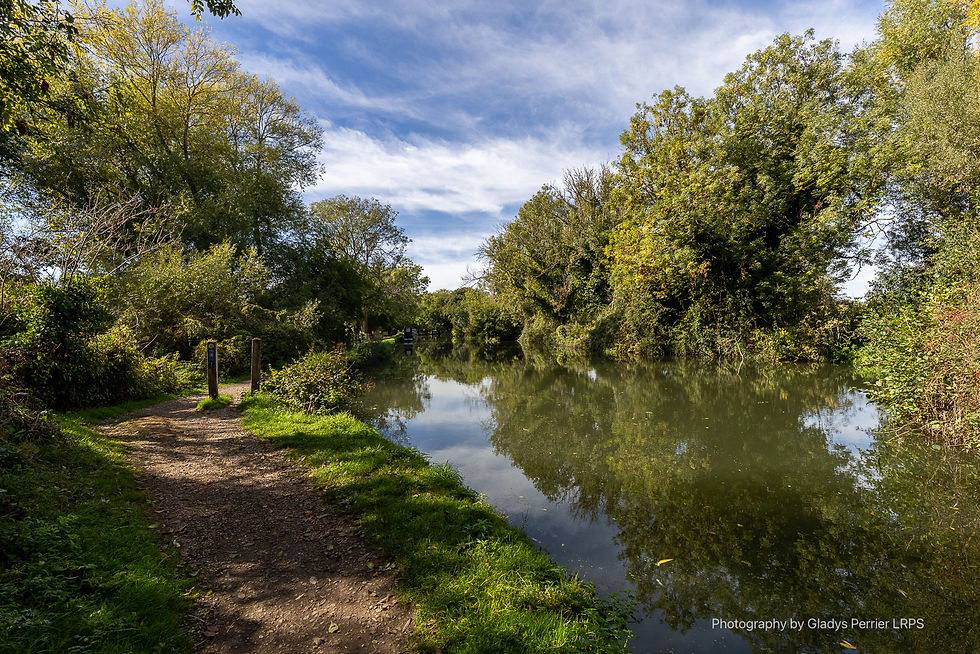
It was not long before we found ourselves in the country away from civilisation, walking in dappled sunlight during what was proving to be a gorgeous day. We had the place pretty much to ourselves but for the occasional cyclist or runner.
At Southcote Lock we took a moment. There is a 5ft 3ins rise/fall in the water level at this point. It struck us that the lock did not have the pristine appearance of so many of the Thames locks. There was no cottage adorned with vibrant hanging baskets. I would assume this is because the lock is self-manned.

We did not hang around to watch these boaters negotiate the sluice gates. We might have been waiting a while.

We did stop and stare at the pounding water below and wonder at the fate of this canoeist.


Southcote Mill appeared rather unkempt but the warm brickwork and the splendid virginia creeper suggested it has huge potential and deserves a bit of love. We could only image sitting on that bench outside with a glass of rosé on a balmy summer’s evening watching the boats go by.

The mill was previously a wire mill making wire out of bar iron supplied by Sowley Forge in Hampshire and powered by the Kennet.
Somewhere along the way we came across a sign for a cunning man. We were a little bit surprised that the sign was not round with a red border around it as one would expect when there is any suggestion of danger. We continued cautiously.


By this point we were getting very hungry but kept going, hoping we would eventually find a bench on which to perch for lunch. The views were glorious but sadly there were no benches, let alone fallen logs, on which to sit.

We checked the map for a nearby church where we can always rely on finding a bench but there were none. Eventually we resorted to sitting on the steps leading up to Burghfield Bridge. It was not going to be the sort of place we would linger or take our boots off however, as I tucked into my coronation chicken and fig jam sandwich I was delighted to be able to point out a kingfisher to Michala. Firstly, he landed on branches over hanging the path and then he shot across to the other side of the canal. When I got up to investigate he then shot off, along the canal. It was a thrilling sighting. We refreshed our palettes on juicy mango, pineapple and melon slices duly provided by Michala. Then it was time to move on.
Refuelled we picked up the pace with new found energy. However, we reigned it in when we were reminded of the danger ahead. There he was, the cunning man. How devious was that. He had obviously tried to deflect our attention by turning the arrow to point away from him. It was obvious he was plotting something. We scurried on putting as much distance as we could between him and us.

Narrow boats were on the move along the canal and one was being moored up, its passengers perhaps headed for the pub. We wondered whether we should warn them of the Cunning Man.

Hanging out at Garston Lock
At Garston Lock we found a WWII pillbox which now houses bats. Nevermind loft conversions, this is a roost conversion. Five of the six openings have been blocked up to insulate the residents and create a dark cosy environment in which they thrive. Apparently, Berkshire is home to 12 out of the 16 species of UK bats. Bunkered down here are some of them including the common pipistrelle, whiskered bat and greater and lesser horseshoe bats. In the evening they will come out to feast on the insects hovering over the still waters of the canal. Quite the place to hang out.

Whilst the leaves on the trees remain green, no doubt something to do with the long summer drought, hints of autumn appeared on the surface of the canal.

No Sense of Direction
We were reminded of our walk along the Thames Path when we discovered a Mills Millenium cast iron mile post near Theale. This one told us we were 8.5 miles from Newbury. You would have thought this would be enough of an indicator to us to avoid going off track but we had not done our homework. This walk had not been planned so we were not fully versed in the route. We knew that St James’ Way starts in Reading and finishes in Southampton. What we had not picked up on was that the path does not take us to Newbury.

Off Course
However, to be fair there was a big distraction. We were drawn to the vision of a tree with crimson tresses.


Michala thought it looked like red tinsel but we are talking about a person who, in the first week of October is already planning the decorations for at least one of her many Christmas trees. She had only just been describing to me the baubles she had purchased. It was quite astonishing. We walked on entranced by this gorgeous sight.
It was perhaps a mile and a half further on that I looked down at OS maps and was kindly informed that we had gone off course. Of course we had gone off course because we had followed the water course instead of turning south.
So retrace our steps we did. We had added an unnecessary 3 miles to our walk and we were now tired. It was now time to think about how we would get home. It made sense to try to catch a train from Theale back into Reading and then out again to Wokingham. It seemed almost too perfect, the station a mere 8 minute walk from St James’ Way. However, true to form, Sunday train travel is never straight forward. The next train due in 50 minutes had been cancelled so we would have a two hour wait. We could not be confident that the next train would not be cancelled as well. So it was that I phoned my daughter Alice and asked her if she might pick us up.
Michala and I continued past the station. Fortuitously there, ahead of us, was the Crown Inn.
The perfect place to bide our time. We slumped into comfy armchairs in the pub garden and sipped on our iced drinks, boots removed. We relaxed until our Alice arrived. What an unexpected day it had been in every way. We were buzzing with excitement for our new goal.


Love the pictures and the story that goes with it.
Exellent piece. Are you branching into prose?