
The Three Castles Path - Day 3
Updated: Mar 26
Michala and I are on a roll. Just a week after our last walk and we were back on the Three Castles Path, this time walking from Hartley Wintney to Ellesfield. We had set ourselves quite a challenge hoping to push it to 17 miles in a day.
Once again, Rich, Michala’s husband, made it possible by driving us in style down to Hartley Wintney dropping us by the golf club at 7:35am.
Hartley Wintney Common
We ‘tee-ed’ off across the road from the course, onto the green, which was a delight of blooming daffodils. The day was very overcast but the sunshine yellow of the daffodils was all we needed to raise our spirits and bring a smile. It was if these trumpets of joy were playing a fanfare to our arrival and the approach of spring.

We lingered by the duck pond where mallards dabbled beneath the bright yellow catkins of the male goat willow.

We were enraptured by the wood carvings of fish, frog, tadpole, heron, dragonfly, swan and butterfly.
We had barely torn ourselves away from the pond only to find another carving, an owl observing us as we crossed from one part of the common to the cricket ground. This was going to be a slow first mile with so much to enjoy.

We walked between the ancient oaks otherwise known as the Trafalgar Oaks or the Mildmay oaks. Lady Mildmay, in response to Admiral Collingwood, had locals plant the oaks for the purpose of supplying the Royal Navy with ship building material following the battle of Trafalgar. Thankfully the oaks were spared their fate with the development of iron and steel.
St Mary's Hartley Wintney
We followed Church Lane up to St Mary's Church where our guidebook mentioned ‘splendid views’. However, today the views were enshrouded in mist but we were not disappointed, enjoying the beauty of this soft veil all around.
Church yards are a wonderful place for wildlife so we were delighted to find a little robin in this, his territory, enjoying his breakfast.

The rich copper of beech hedges brightened the otherwise muted colours of the landscape. In the woodland the holly was a rich glossy green.

We emerged into meadows lined with a tapestry of textures from lichen covered branches to the pendulous golden catkins of hazel and the vibrant green of grass coming back to life after dormancy through the winter.

The trees were soft and ethereal against the misty shroud.

Momentarily we left behind nature to cross above the roar of traffic along the M3 motorway, a rude reminder of life’s pressures. Suddenly the world seemed dark and dreary but not for long.

Walking down from the footbridge we encountered a few farm animals happy for us to break the monotony of their day.

The cobb trotted over to us. Michala of course fell in love straight away, however she did have a tinge of regret for scratching him under the chin when she realised just how stinky he was. Thankfully I had some hand sanitizer in my rucksack. I was happy to admire the donkey and bedraggled pony from a distance.

Going under an archway of blackthorn we continued along muddy, squelchy paths reducing our pace to avoid slipping.
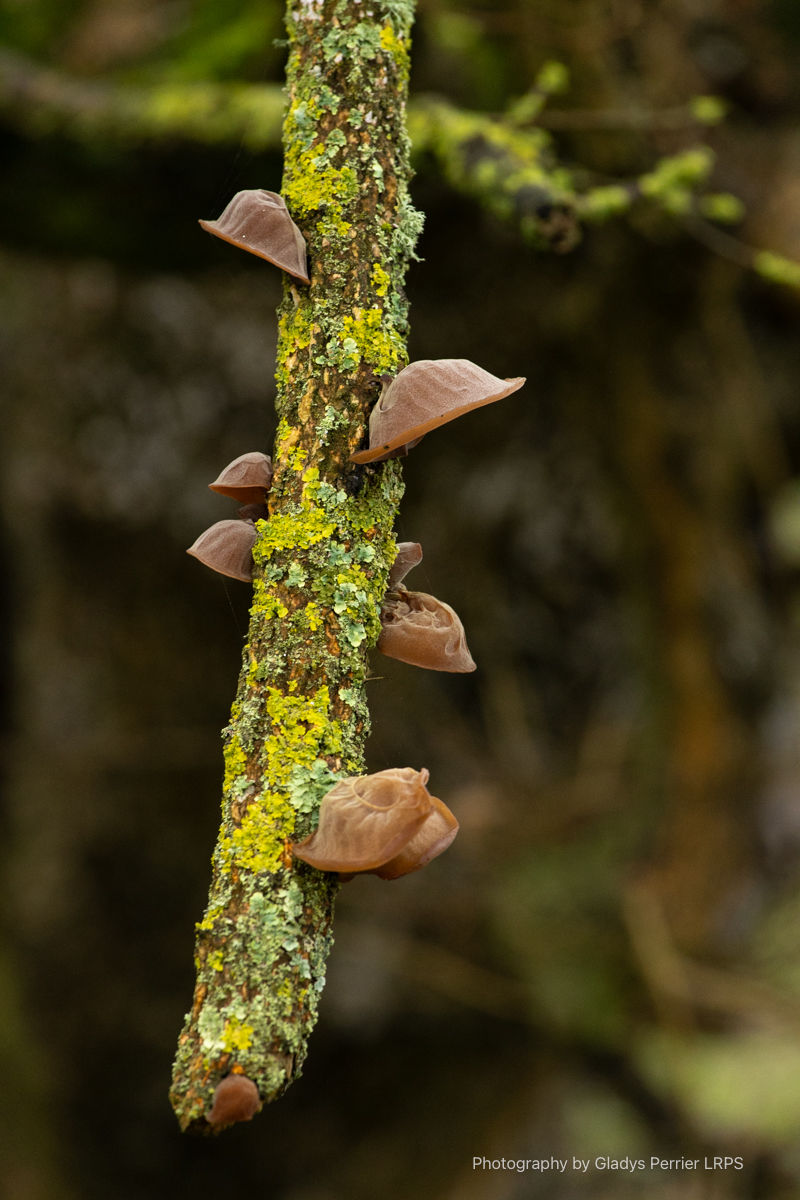
We were ever cheerful at the wonderous sights of wood ear fungi sitting apon a lace of green and gold lichen and bushes of gorse coming into bloom.
Winchfield St Mary's

We emerged out onto the road and crossed under the railway bridge, heading for Winchfield's Norman church of St Mary’s. (The second of a total of three St Mary’s we were to visit on this day). Looking through a veil of trees, we spied a group of roebucks ever nervous and watchful.

Rich golden clusters of flowers hung down on the ancient male yew trees.

The church doors were locked but just as we were about to move on, a gentleman came up the church path and unlocked the heavy oak doors for us, providing us the opportunity to admire the interior. The church was originally a Roman Catholic shrine built for the Monks of Chertsey in 1150. Particularly of note were the Norman arches, firstly the porch arch leading into the church and then the chancel, both carved with an unusual pattern of chevrons.


The guide suggested we dallied and dally we certainly did before eventually moving on to enter Hellet’s Copse through V-shaped stiles. The mud slowed our pace considerably and begged the question as to whether our hope to cover 16 miles in the day might be perhaps over ambitious.

The Basingstoke Canal
However, at this point we joined the tow path along the Basingstoke canal starting at Stacey’s Bridge. The flat terrain enabled us to pick up the pace a little – but not too much as we had to stop and admire along the way.
Whilst the mist lingered, the red brick of the canal bridges gave an illusion of warmth as did the banks of last autumn’s leaves.

The mist hung like a stilled breath over the water creating a sense of silence and only broken by the dripping branches over hanging the canal and rippling across the surface.

Out of the brooding mist and silence came vivacious chatter and vibrant colours as two ladies – both remarkably called Merina – paddling in their kayaks through the silken surface and what a joy they were.

Their smiling faces and laughter felt like sunshine.

As their bubbly chatter receded into the distance a soft silence cushioned us and filled us with a sense of calm. The gentle palette of colour created by the mist contrasted with the lichen covered branches hanging over the canal, like some creature waking from a deep sleep, stretching out its arms. The season was on the turn. This long winter will soon be gone.

The Three Castles Path continued along the Basingstoke canal under Sprats Heath Bridge, Sand Hill Bridge and Broad Oak, soothing us as we knew that for 4.5 miles we would not have to think about directions.
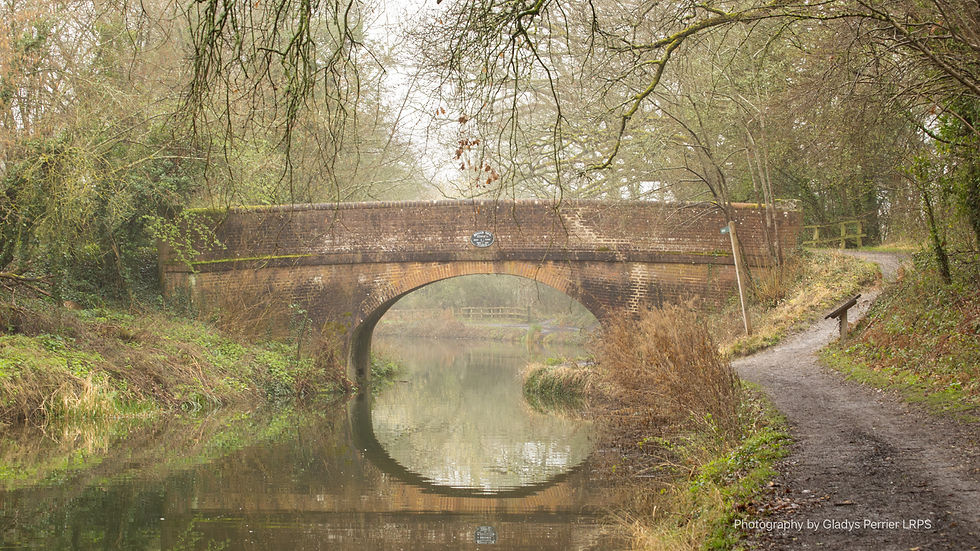
We passed the occasional fisherman, runner, cyclist or walker but on the whole the silence was broken only by the trills of wrens, the clucking of the blackbird startled by our presence, the song of the robin protecting his territory, the slightly muddled chiff chaff of the chiff chaff and the delightful whinnying trill of little grebes.


Water Witches
At this stage we reckoned we had covered nearly a third of the distanced planned for the day so we decided this was a good point at which to take a break. We crossed over the bridge at Colt Hill and us two Water Witches walked our muddy boots into the local public house, but not without checking for approval.

A friendly young lady served Michala a little pot of tea and me my usual cappuccino with chocolate sprinkles on top. I removed my muddy boots to wriggle my toes knowing how refreshed they would feel when I eased them back into my Scarpas.
The Water Witch was cosy and warm and we could have stayed longer but it was time to move on. Our somnambulance was broken as the cold air hit us as soon as we stepped outside. We donned our hats and zipped up our jackets stopping only to admire the little house sparrow who thought he had hidden so well in the hedge.

Odiham Castle
High up in the tree tops the corvids cawed in excitement as cronies came and went. They were not the only ones who were excited. Whilst we were in the pub the canal side seemed
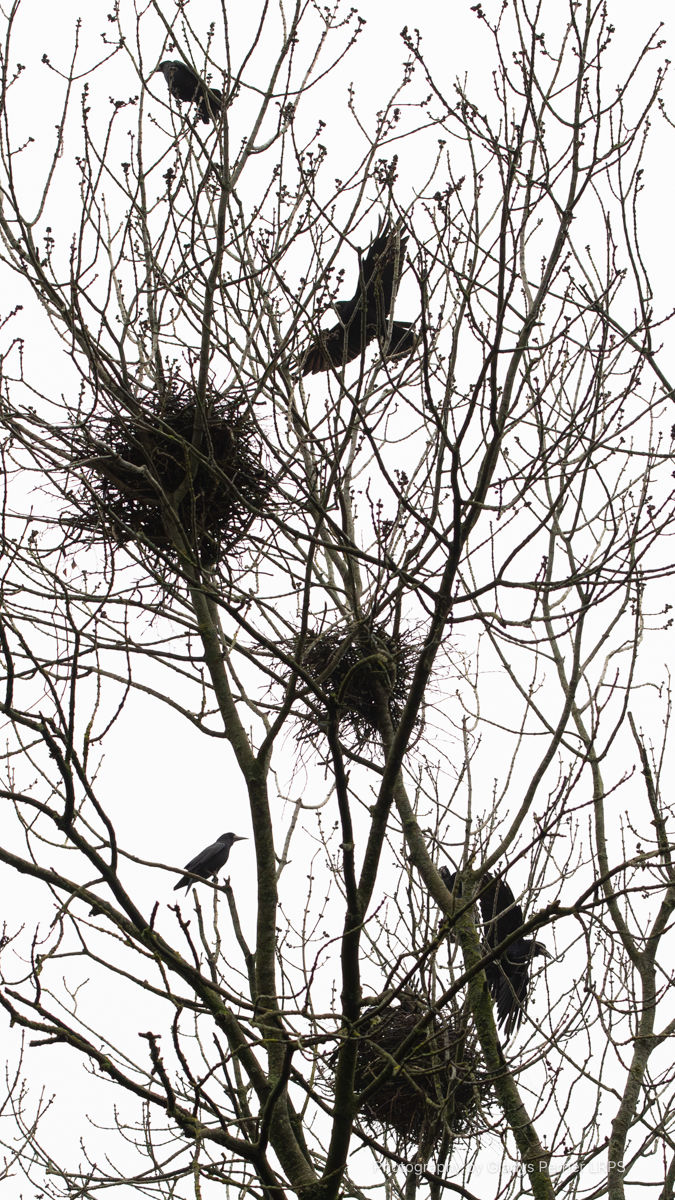
to have become a lot busier with families of children on bikes and scooters. We must not be selfish about wanting this all to ourselves. It is great to see children enjoying the outdoors.
We found ourselves a bench near Odiham Castle. We had reached the halfway point along the Three Castles Path from Windsor to Winchester. We decided to eat the first half of our lunch and wait it out until the various groups had moved on. I nibbled on my homemade coronation chicken wrap whilst, of course, I settled my thoughts on King John. Whilst the groups of children and dogs lingered on I accepted Michala’s offer of mouth-watering mango to cleanse the palate.
Replete, it was time to explore the ruins of King John’s castle at Odiham. This was King John’s answer to breaking the two-day horse ride between Windsor and Winchester. It would have been from here he rode out on 15th June 1215 to seal his approval of the Magna Carta and the foundation of statutory rights (though King John and many after him failed to comply).
The basis of the charter is all there in place in this plaque providing the perfect aide memoire for any school child learning about this period of history.

Having circumnavigated this, the second castle of the Three Castles Path, we rejoined the canal.

Greywell Tunnel
Not much further along we found ourselves at the Greywell Tunnel well known for being the roosting place of about 12,500 bats of which there are 8 species.

Beneath the surface of the canal we observed the most exotic of worlds with beautiful fronds of flowing acquatic plants in multiple shades of green and gold. It appeared like an exquist piece of applique adorned with different fabrics and textures. Apparently, the Basingstoke Canal is ‘botanically the most species-rich aquatic system in Britian’. The Greywell Tunnel itself is a designated SSSI with its bat roost.
Our 4.5 mile walk along the canal complete, we turned away walking through Greywell village, past beautiful timbered houses with wisteria entwined across the frontage and through the red brick work - no doubt even more beautiful when in bloom.

Greywell St Mary's
From here we visited another St Mary’s Church, Norman by origin but added to over the centuries. Then we followed a wooden walkway to the crystal clear waters of the Whitewater, making a very brief visit to the mill. It looked a little dishevelled and in need of much tender loving care, not quite the delightful location as described in my 30 year old guidebook.
From common ground, to woodland, canal side and riverside the terrain changed again and we were now climbing the sloping fields where pheasants skulked while ducks roosted. With no sun today the ground remained sodden and yesterday’s heavy rain clung like jewels to the bent grasses.

From arable fields back into woodland, a tangle of ivy clad tree trunks interspersed with shiny holly and glimpses of ploughed fields ready for planting. The mist beyond gave the illusion of the day brightening.

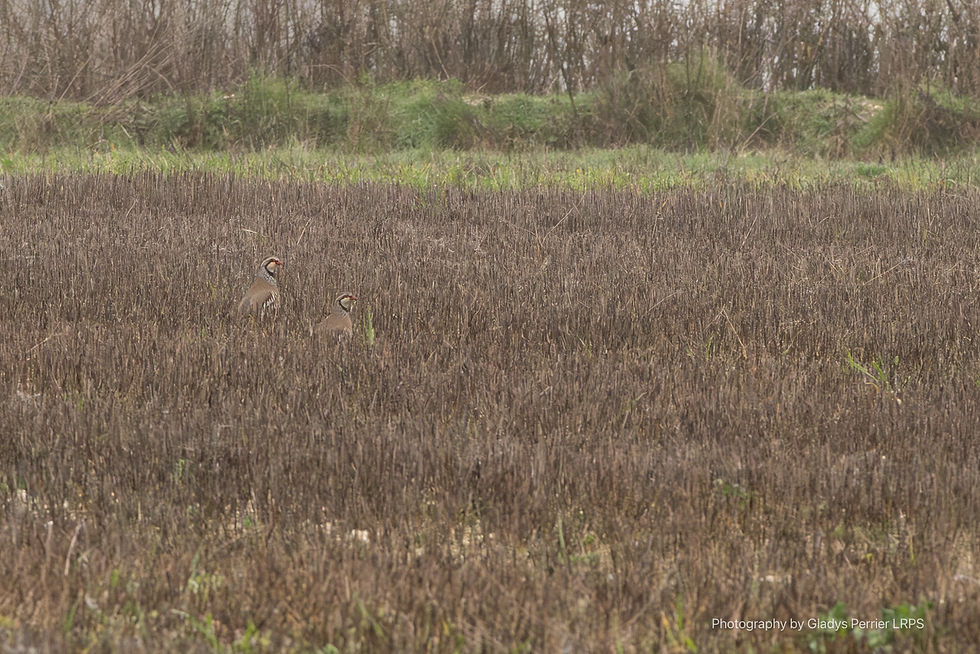
Camouflaged among the stubble appeared the telltale sign of the red-legged partridge with
its bold black frame on his bib, a hint of barring and his red bill only just enabling us to spot them as they walked away at speed rather than take flight.
Arriving at Five Lanes End my attention was drawn to the beautiful canopied arch of trees below but our walk took us in a different direction.

Our pace was fast despite having many a puddle to negotiate around.

Tunworth All Saints Church and School House
We arrived in Tunworth, passing the old school house. I have long been collecting images of weathervanes and this provided me with a favourite to add to the collection, closely follow by another.
Then to the church and no, not St Mary’s, this time All Saints. On this occasion the church was locked so we did not dally.

With a glance to the side, we kept going at a pace not wanting to upset the locals.

By now we were tired. We could have chosen to end our walk here and call Rich to pick us up finishing at stage 9 of the guidebook. We looked at the map noticing that we would be crossing the Basingstoke to Alton Road at Winslade which might offer the opportunity to be picked up. We had four more miles to reach our original goal. Whilst debating, we stopped for the second half of our lunch. An opportunity to refuel. We sat on a rather high green wrought iron bench which meant our feet were fully rested, unable to reach the ground. This was just what we needed to restore our energy and push on having alerted Rich of our ETA.
Fortunately, the way was not as squelchy and slippery as much of the paths up until now. We were able to increase our pace a little. As usual we enjoyed setting ourselves a goal to reach our destination of Ellesfield by 5:30pm.
Turning into woodland we by passed a little Methodist Church along the way. Then we continued along grassy paths and through open fields.

We trod along sunken paths and challenged ourselves further as we reached the highest point along the Three Castles Path at 646 ft. Our spirits were strengthened as we found a distance marker showing us how much we had achieved in under three days.

In that final stretch, with ivy clad trees bending in over the path it felt like a welcoming crowd cheering us as we reached today’s goal arriving in Ellesfield a little ahead of time.

However, for us it was not quite over as we had arranged to meet Rich at the Fox Inn. Despite our sense of fatigue this offered the opportunity to see something of the village described by locals as ‘heaven on earth’. Certainly, St Martin’s Church looked quite delightful with the splash of colour in the church yard and even more delightful was the warm welcoming lights of the Fox Inn where our driver awaited with our chariot home.

If you would like to read about the next leg click here.


Comments